 Catalogue
 Novelties
 Projects
 J3 Play structures
 Swing sets
 Slides
 Sports equipment
 Site furniture
 J2 Courses
 Inclusivity
 First Nations
 Outdoor Classroom
Jambette: Visionary (part 3)
The reinvention of public spaces: much more than places to pass through!
By Marie-Noël Grenier | Read time 4 minutes | Published on
Categories: Enterprise, Latest news
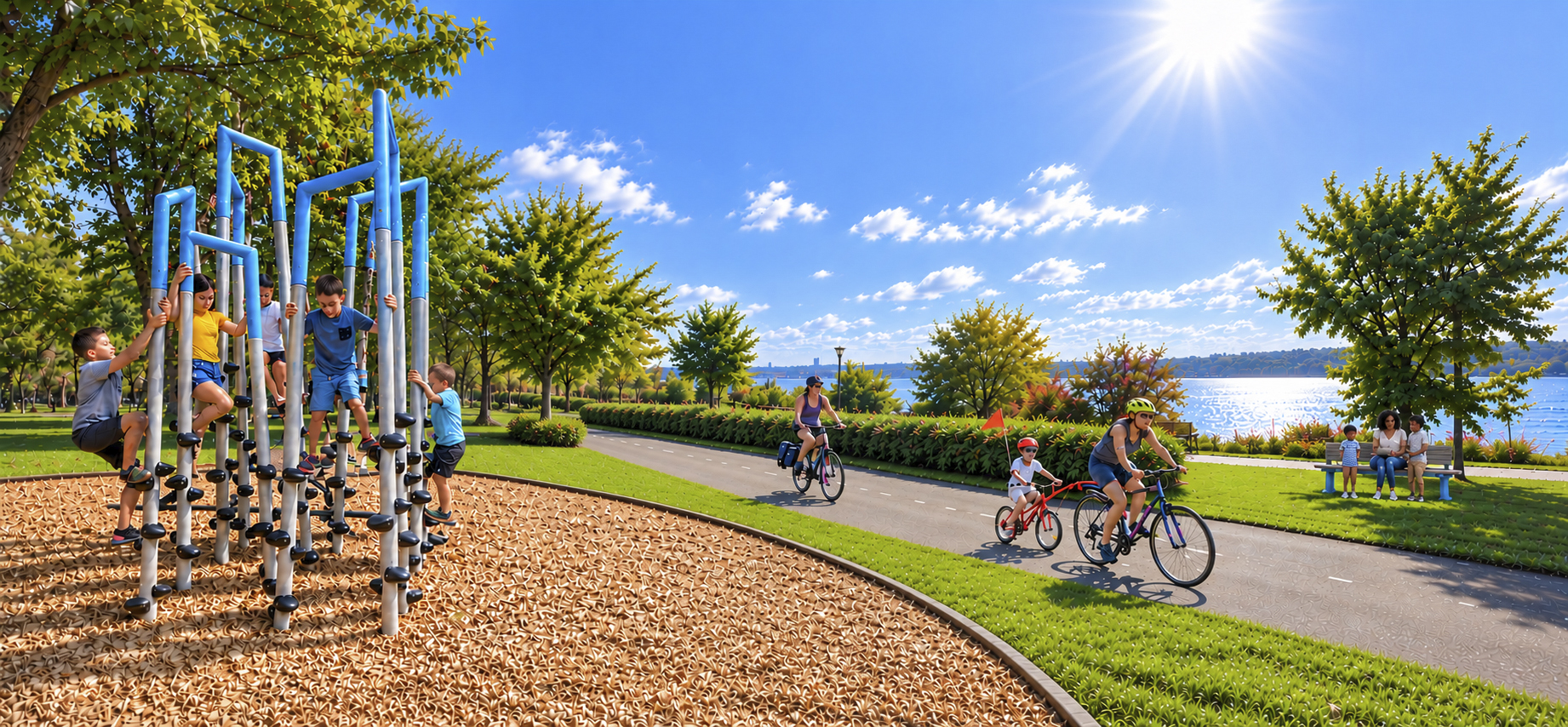
What if our parks, trails, and public squares had become true living spaces? Places where people come not only to be active, but also to meet up, share experiences, relax, and be in the moment.
Today, public spaces far exceed their primary function. They are becoming third places, spaces for encounters and freedom that fit between home, work, and daily obligations.
This transformation invites us to rethink their design and, above all, the experiences they can offer.
One space, and a thousand ways to experience it!
A bike ride, a break on a bench, a family picnic, or a spontaneous encounter in the park: behind these simple actions lie very different expectations.
Public spaces welcome people of all ages and backgrounds. We can differentiate four main ways people use them:
- Solo: to disconnect, recharge, or be open to meeting new people.
- In tandem: to share a special moment and enjoy an experience together.
- With family: to play, discover, strengthen bonds, and meet other families.
- In a group: to celebrate, share a passion, or simply cultivate the joy of being together.
The challenge lies in designing multi-purpose spaces that meet this variety of needs, while promoting the harmonious coexistence of diverse users.
From simple routes to actual destinations
For a long time, trail development consisted mainly of creating a safe and functional path. Today, expectations have evolved.
We no longer want to get from point A to point B only. We want to enjoy the journey, stop, contemplate, discover, and stretch out our visit.
Rest areas, lookout points, play structures, and cultural installations now enrich the experience.
The Samuel-De-Champlain promenade in Quebec City and the Véloroute des Bleuets in the Saguenay–Lac-Saint-Jean region are good examples of this evolution.
Public space is no longer limited to what we can do there. Its true value lies in what we can experience there.
Leisure: an experience before it's an activity
What transforms a simple visit to the park into a memorable moment?
It's primarily the experience itself and the emotions it evokes.
Leisure fulfills a deeply human aspiration: to feel free, to enjoy what we do, to achieve fulfillment, and to reconnect with ourselves, with others, and with our environment.
A successful experience combines freedom, fun, involvement, interaction, and discovery. It can even ignite that feeling that makes us go "WOW!"
Think of a family outing to the park. First, there’s the anticipation: the children are eager, and the parents picture a wonderful day. Then comes the experience: games, laughter, fun encounters, and discoveries. In the end, the memories remain, along with the desire to do it all over again.
We dream of it. We live it. We remember it. We talk about it. And we want to do it again.
Designing spaces that keep people coming back
This evolution is transforming the way we plan public spaces.
A park can become a true hub for leisure activities, where play, relaxation, exploration, physical activity, and socialization come together.
To make this happen, we must understand the aspirations, habits, and abilities of the people who use it.
The goal is no longer to simply install more equipment, but to create environments that foster rich, accessible, and memorable experiences.
Third places thus contribute to the vitality of our communities. They bring generations together, promote inclusion, and strengthen our sense of belonging.
What if the true measure of a park's success wasn't just its attendance, but also the enjoyment people find there and their desire to return?
Because the most beautiful public spaces aren't simply those we visit. They are the ones we make our own, the ones that bring us together and leave lasting memories.
____________
Jambette: Visionary is a series of reflections on the evolution of recreation and public spaces, produced in collaboration with André Thibault, Professor Emeritus at the Université du Québec à Trois-Rivières and a specialist in public recreation.